



"Diseases of civilization" are well known to every modern person - these are difficult-to-treat allergies, frequent ARVI, runny nose and bronchitis, chronic fatigue and asthenia, stomach and intestinal problems, abdominal pain.Obsessive symptoms that force you to change your lifestyle and cause a lot of anxiety are often the reason for multiple visits to doctors.Treatment ends, but symptoms remain.
What can such violations indicate?
Deterioration of health, increased symptoms, unexplained manifestations of various body systems - respiratory, immune, nervous, digestive and others are generally "looked at" to the modern busy rhythm of life, constant emotional and physical stress, which leads to general fatigue and reduced immunity.In fact, there can be many reasons for this situation, and often the malfunction is caused by only one negative factor, for example, helminthic infestation.You should consult a doctor - a therapist, gastroenterologist or immunologist-allergist - to determine the exact cause of the discomfort and also to find out whether there is an infection with parasites.
If there is a doubt about the presence of parasites as the cause of the disease, the doctor prescribes tests for the presence of parasites.There are several tests to identify helminthiasis.In most cases, the treatment is quite simple: special anthelmintic (anthelminthic) drugs are selected.If you ignore the problem, the presence of parasites in the body can lead to serious diseases and sad consequences.
Symptoms of parasitic infection in adults
Most adults associate helminth infection with children, and there is an explanation for this rooted idea: helminth infections are really common in childhood, because young children may not follow hygiene rules, are in large groups of children, etc.However, helminthiasis also occurs in adults!Moreover, parasites in the body can cause symptoms that a non-medical person would never associate with a helminthic infection.
For example, parasites can contribute to the development of allergies, because they themselves (and their metabolic products) are allergens, and they also disrupt the activity of immune protection mechanisms, which leads to a decrease in immunity.Various allergic reactions (runny nose, lacrimation, skin rashes, swelling, diarrhea) develop to familiar foods, pollens, household dusts and they intensify quickly.Against the background of changes in the immune system, acute respiratory viral infections are often observed and general health deteriorates.
When infected with parasites, it is present in the part of the digestive system
- pain in the upper abdomen, near the navel,
- swelling often occurs
- diarrhea,
- painful cramps in the lower abdomen,
- constipation,
- itching
Such symptoms may indicate an infection with roundworms that live mainly in the small intestine, which is why the listed unpleasant sensations develop.Painful cramps in the lower abdomen, constipation and itching in the anus are more characteristic when infected with pinworms, because they are localized in the large intestine.With all helminthic infestations, the appetite is disturbed, and this can not only disappear, but also intensify.
Some helminthic infections, for example, echinococcosis, opisthorchosis, are asymptomatic.
Complications of helminthiasis that develop without treatment include the following (some of them are listed):
- anemia occurs due to impaired absorption of nutrients from the intestine, absorption of vitamins and proteins;studies show that even mild helminthic infestation can cause disorders;
- intestinal obstruction - mechanical blockage of the intestine, most often occurs in children up to 10 years old, but adult patients also appear in world statistics;intestinal obstruction can cause death;
- bronchial obstruction (with ascariasis) and corresponding manifestations from the respiratory system;
- Jaundice due to obstruction of the bile ducts (with ascariasis).
It is important!An adult can become infected with parasites by consuming thermally unprocessed food (fish, meat) or insufficiently washed greens.Dangerous helminths enter the human body from domestic animals - dogs, cats, turtles, etc.
Diagnosis of helminths
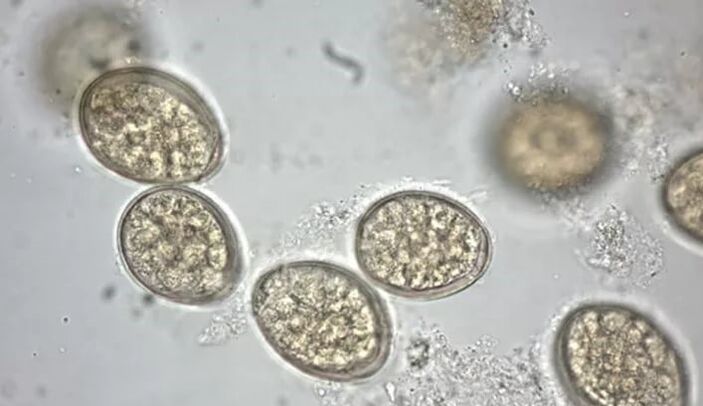
Due to the characteristics of the life cycle of parasites, it is quite difficult to detect some helminthic infestations in feces, for example, with ascariasis, in such cases it is necessary to determine antibodies against helminths in the blood.When identifying pinworms, the analysis is informative (accurate).
Blood test to determine antibodies against helminths
These studies are prescribed to determine the presence of pathogens such as roundworm, toxocariasis and others in the body.The tests are accurate and allow you to determine the presence of a parasitic infection.
It is important!At the end of the treatment, it is necessary to check its effectiveness (removal of parasites) by conducting repeated studies.
Frequent tests - specific tests for helminthic infestations, as well as general and biochemical blood tests - help identify more dangerous health problems that require immediate treatment and can be fatal.For example, together with tests for helminth infections, tests are prescribed to identify hidden viral infections that seriously damage the body and weaken the immune system - for Epstein-Barr virus, cytomegalovirus and others.That is why any test prescribed by the doctor can provide him with important information about the reasons for the patient's poor health and allow him to start targeted treatment in time.
Treatment of helminthiasis in the clinic
Despite the unpleasant condition, most helminth infections are treated using special drugs.Modern anthelmintic drugs are well tolerated, do not cause serious side effects, and if the treatment regimen is followed, they are selected individually by the doctor, taking into account the condition of the body.Strict adherence to the rules of taking medication guarantees the complete removal of parasites from the body.
But the treatment does not end there.It is necessary to eliminate the consequences of helminthic infestation in the body, therefore, the doctor prescribes drugs that improve digestion (enterosorbents, probiotics, anti-inflammatory drugs), antiallergic drugs, expectorants, anti-anemia drugs (iron supplements), vitamin-mineral complexes, etc.In particular, I would like to note that therapy is always strictly individual and depends on the characteristics of the body of each individual patient, so it is best to carry out the treatment under the supervision of a doctor.
The clinic provides a unique opportunity for patients to improve their body health with herbal medicines.A gastroenterologist certified as a herbalist will individually select a herbal mixture based on medicinal plants with anti-inflammatory, antihelminthic and antiallergic effects.Herbal medicine courses help normalize digestion and relieve discomfort - heartburn and belching, bloating and stool disorders, body recovery and support as comfortable as possible for the patient.In the clinic, homeopathic treatment is also used as a supportive treatment, because these drugs have a mild complex effect on various body systems.